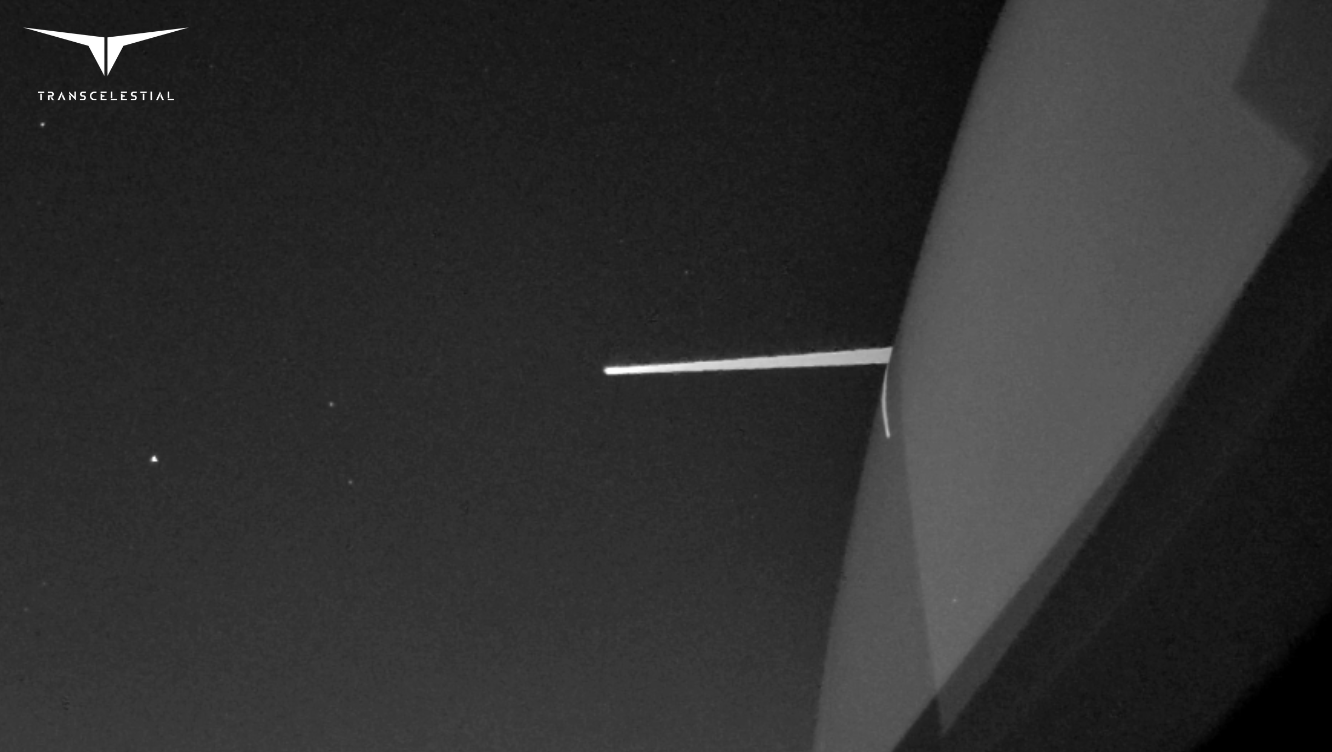
Footage of Transcelestial’s Optical Ground Station in Singapore tracking its 1Gbps Downlink terminal on the 6G StarLabs satellite
SINGAPORE, 12 MAY 2026: Transcelestial has successfully established recurring optical acquisition and tracking of its orbital laser terminal from operational optical ground stations in both Singapore and Spain, marking a major step toward geographically distributed space-to-ground laser communications infrastructure.
Rohit Jha, CEO and Co-Founder of Transcelestial said: “Transcelestial is World’s First Venture-backed startup to deliver end to end laser comms connecting earth to deep space. This is critical to unlocking ultra fast LEO networks and Orbital Datacenters for AI. Our teams are world class in not only building laser comms terminals and networks but also scaling with manufacturable, COTS designs. We are looking to scale to dozens of these optical ground stations (TMOGS) all connected via terrestrial networks, over the next few years. This will enable real time access to anyone operating our laser terminals in space.”
The milestone moves the company beyond isolated single-site demonstrations and into scheduled multi-site optical operations across two continents under its own operational control.
Transcelestial is among the first commercial operators to maintain a commissioned, multi-continent optical network integrating both proprietary orbital laser hardware and operational optical ground stations under a unified operational stack.
As part of the campaign, Transcelestial successfully acquired and tracked its orbital laser hardware from both locations using the company’s proprietary optical ground stations, validating recurring closed-loop pointing and tracking between space and ground.
Video 1 – Initial Acquisition of target satellite via blinking lasers
Video 2 – Post Acquisition mode smooth tracking LEO satellite (bidrectional, full duplex)
Video 3 – Tracking 6GSTARLAB satellite in orbit
Video 4 – Optical Ground Station in Singapore Seen through our onboard tracking sensors
The Singapore and Spain sites now support scheduled recurring observation windows of the spacecraft as it passes overhead, with additional optical ground stations planned in Australia and the United States as the company expands its global network footprint.
The acquisition process uses a distinctive optical signature between the spacecraft and ground stations to establish mutual identification, closed-loop pointing, and continuous tracking before transitioning into data operations.
Internally designated as “Phase 3” of the mission, the campaign focused on validating both multi-site optical ground infrastructure and recurring acquisition performance across geographically separated locations.

The company says the effort forms part of a broader roadmap toward persistent high-speed optical communications networks capable of moving significantly larger volumes of data between orbit and Earth than conventional RF systems.
The milestone builds on the company’s earlier in-orbit activation and flight qualification work following launch aboard SpaceX’s Transporter-15 mission alongside Open Cosmos and i2CAT.
With the recurring acquisition phase now operational, the company will proceed toward full repeatable optical data transfer between space and ground.
——- END OF ANNOUNCEMENT——-
For press enquiries and requests, please contact: Rachael De Foe ([email protected])
For more, visit our website www.transcelestial.space OR follow us on X (@trans_celestial)
For sales enquiries, please contact: [email protected]
For more information, visit https://linktr.ee/transcelestial